William Chester Minor
The Surgeon of CrowthorneWilliam Chester Minor was an American Army surgeon, a man with substantial means and an education in medicine, whose life was redirected by a serious and persistent mental illness. After he was found not guilty of murder on grounds of insanity, he spent decades in Broadmoor Asylum, where he became an unusually important contributor to the Oxford English Dictionary. His history links confinement and changing ideas about mental illness with a demanding scholarly collaboration that gave him purpose and secured his name in the dictionary.
Identity and the onset of illness
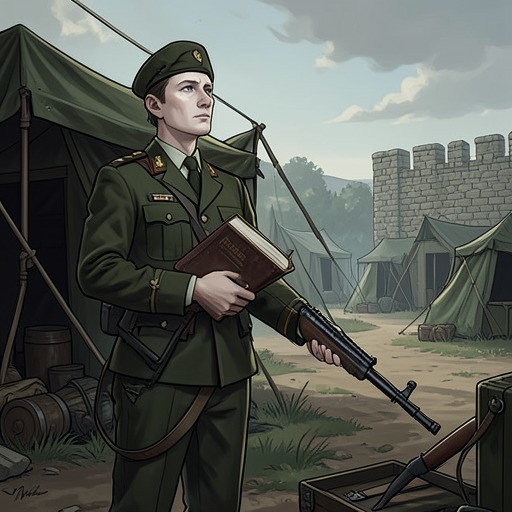
Minor was thirty-seven when he was arrested in London in February 1872. A former United States Army officer and qualified surgeon, he had been in the city for less than a year and lived alone in a furnished room at 41 Tenison Street. Although he had no financial need to live economically, his reasons for settling in the Lambeth district were not established in the early police questioning. He came from New Haven, Connecticut, and his American military commission made the case an international matter as well as a local murder investigation.
The signs of illness had appeared earlier. During the summer of 1868, while serving in Florida, Minor developed severe headaches and vertigo. He was sent under escort to New York for examination by doctors familiar with his service. On 3 September, Surgeon Hammond assessed him as suffering from monomania, a period term for an intense fixation on a single subject, and regarded him as delusional. The subject of the fixation was not recorded in that assessment. Subsequent medical notes judged him unfit for duty or travel, and by November army doctors recommended institutional care because his condition had become suicidal and homicidal.
The evidence does not settle what caused his illness. The account considers, without claiming certainty, whether the Battle of the Wilderness or other wartime experiences could have contributed, and raises possible genetic and temperamental factors as well. It also notes that two of Minor’s relations had died by suicide, while emphasizing that the circumstances are uncertain. These possibilities remain explanations under discussion, not established causes; the record offers no single event that conclusively accounts for his decline.
London, the murder case, and confinement
On 17 February 1872, shortly after two in the morning, three revolver shots were heard in Lambeth. Minor had killed George Merrett. At the time of his arrest he was carrying a surgical instrument, and by dawn he had been charged with murder and taken to Horsemonger Lane Gaol. The shooting was particularly shocking in a city where firearm crime was considered rare. Minor’s nationality and United States Army service prompted officials to notify the American authorities in London.
The fuller account of his delusions emerged at his trial in April. Minor had repeatedly gone to Scotland Yard to report that men were entering his room and trying to poison him. He identified the imagined persecutors as Fenians and described threats involving his lodgings. He had also written to the police in January, saying that he believed he had been drugged and that the men planned to kill him and make his death appear to be suicide. His landlady had noticed his anxiety, his requests to move the furniture, and his fear that people might break in; she also reported his insistence on knowing whether Irish servants or visitors were in the house.
Under the M'Naghten Rules, the jury was to consider criminal responsibility in light of whether a defendant was of unsound mind and acted under delusion. On 6 April 1872, the jury found Minor not guilty on grounds of insanity, without deliberation. The verdict did not deny that he had killed Merrett; it determined that he was legally not responsible because of his mental condition. The judge ordered his detention until the monarch’s decision, and the Home Department sent him to the newly established Broadmoor Asylum in Berkshire.
At Broadmoor, Minor was registered as Patient Number 742 and classified as a criminal lunatic. The admission record described a thin, pale, sharp-featured man with light sandy hair, deep-set eyes, and prominent cheekbones; it gave his weight as ten stone and one pound and classified him as dangerous to others. It also recorded his belief that unknown persecutors were trying to harm him with poison. These administrative descriptions preserve a stark contrast: the former army surgeon and member of a respected New England family was now defined by an institutional number and a legal-medical category.
Dictionary work and a scholarly purpose
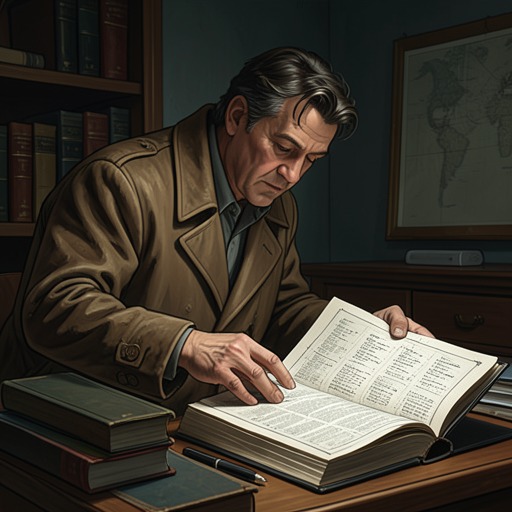
While confined at Broadmoor, Minor volunteered to read for James Murray’s dictionary project. The precise beginning of his work is uncertain. Murray later recalled receiving a letter from him soon after starting the dictionary, but no surviving correspondence has been traced before 1885. An article in the Athenaeum in 1879, Murray’s recollection, and records of Minor’s contributions together make 1880 or 1881 the probable starting point. Murray initially knew him only as a correspondent whose letters came from Broadmoor, Crowthorne, Berkshire; he did not realize that the address belonged to an asylum.
Minor’s usefulness became evident in his submissions. In response to a request for material on a word, other readers sent a sentence or two, while he supplied twenty-seven quotations. Many of those for this particular word came from Sir Joshua Reynolds’s Discourses, but they were valuable to the dictionary staff. The first known quotation from Minor to appear in the completed work was drawn from Reynolds’s 1769 text and placed under the sense relating to the arts. The entry made his contribution visible not merely as private correspondence but as evidence incorporated into the published dictionary.
The work also gave shape to his confined days. The account presents the routine of reading and sending quotation slips as a sustained intellectual stimulus that appeared to offer some relief from his paranoia. It became a fixed purpose within a life restricted by illness and custody. The book’s eventual completion removed that organizing focus, and the narrative connects its disappearance with Minor’s subsequent decline, without suggesting that dictionary work cured his illness.
Friendship with Murray and the disputed first meeting
Minor and Murray eventually met in person, but the familiar story of their first encounter was a later invention. In the popular version, Murray arrives expecting to visit a fellow scholar, discovers that his correspondent is an inmate, and is astonished to learn that a murderer helped make the Oxford dictionary. Hayden Church publicized this dramatic account in 1915. It captivated readers during the First World War and became the version repeated in many later tellings.
A letter Murray wrote to Francis Brown in 1902 gives a less sensational account. Murray had learned that Minor was an inmate and was invited to visit him. The visit took place in January 1891, six years earlier than the date attached to the romantic legend. At Broadmoor, Murray spent many hours with Minor in his room or cell, before and after lunch. He found him cultivated, scholarly, artistically interested, and, as far as Murray could judge, sane. Murray also learned that Minor gave a substantial part of his income to support Merrett’s widow, who regularly visited him.
The meeting began a personal friendship that lasted almost twenty years, grounded in mutual respect and a shared love of words. Murray valued Minor’s contribution to the dictionary, while Minor regretted the limits confinement placed on his ability to be useful. The contrast between the real encounter and Church’s invented discovery scene matters: their relationship was not a sudden revelation staged for effect, but a sustained connection formed through years of correspondence and scholarly work, then continued through visits.
Diagnosis and legacy
Minor’s psychiatric classification changed over time. On 8 November 1918, while he was a patient at St Elizabeths Hospital, psychiatrist Dr Davidian recorded a diagnosis of dementia praecox, paranoid form. The book treats this as an early recognizable modern description of his condition, not as a timeless label. Dementia praecox had been named by Emil Kraepelin and referred to an early loss of contact with reality; the term was later associated with schizophrenia. This vocabulary differed from the Victorian descriptions of monomania and paranoia that had framed earlier assessments of Minor.
The account resists certainty about either diagnosis or cause. It discusses the possibility that wartime experience helped bring symptoms to the surface, while noting that Minor’s long-lasting condition cannot simply be explained as a temporary response to trauma. It also considers how the treatment available in his own time differed from later psychiatric care. These retrospective comparisons place his case within the history of medicine while leaving unresolved what, in his particular life, initiated the illness.
Minor’s contribution to the Oxford English Dictionary provides a counterweight to the record of illness and confinement, not an erasure of it. The completed dictionary formally acknowledged his work among that of its contributors. His name, preserved within the reference work he helped build, joins the disciplined accumulation of quotations to the less visible story of a reader writing from Broadmoor. The result is an enduring irony: a life constrained by delusion and institutional custody nevertheless entered the history of English through patient, collaborative scholarship.